


Buy Fire Truck Replacement Parts Online: 2026 Review
Table of Contents
- Why Buying Fire Truck Replacement Parts Online Beats Waiting on Backorders
- Quick Comparison: Common Replacement Parts and Prices
- Scene Lighting Replacement Parts Reviewed
- How NFPA 1911 Compliance Parts Fit Into Your Replacement Plan
- What Separates Reliable Emergency Vehicle Parts Suppliers From the Rest
- When Custom Fire Truck Equipment Fabrication Makes More Sense Than a Stock Part
- How to Verify Part Numbers Before You Buy Fire Truck Replacement Parts Online
- Conclusion: Matching the Part to the Failure
- Frequently Asked Questions
Last Updated: October 4, 2026
Why Buying Fire Truck Replacement Parts Online Beats Waiting on Backorders
Buying fire truck replacement parts online means ordering the exact component you need from a supplier's live inventory instead of waiting weeks for a distributor to route it through a warehouse.
The math is unforgiving. A truck out of service means another apparatus covers its calls, and that strains the whole fleet.
Below, we break down what common replacement parts cost, which lighting components fail most often, and how to verify a part number before you click buy.
Quick Comparison: Common Replacement Parts and Prices
Prices for the parts we stock are listed below. Every one of these is a one-time purchase with no subscription or minimum order.
| Part | Price | Fits |
|---|---|---|
| Bulbs, Focus, Optimum, Halogen Replacement | $82.32 | Focus, Optimum, NightMaster lampheads |
| Magnafire Bulb End Repair Clips KRM003927 | $78.98 | Magnafire 3000 and 5000 lamp heads |
| FRC Bulb Clips, Sockets for Quartz Halogen Bulbs | $109.20 | Focus and Optimum scene lights, quartz halogen only |
| Square Base Mount Replacement | $135.96 | Collins Dynamics CD-FX-12 and SoBrite flood lights |
| FRC Swivel Joint Mount Repair FC504K | $141.93 | Optimum, Focus, Spectra, Evolution light heads |
| Replacement Tempered Glass for Focus and Evolution II | $151.33 | Focus 500, 750, 1000, 1500 watt and Evolution LED |
| Replacement Tempered Glass for Optimum Light Heads | $181.85 | Optimum scene lights |
| Cigarette Lighter Plug with 9 ft Retractable Cord | $64.00 | 12V, 16 gauge portable light connections |
| Inner Pole Replacement 510, 512, 530, 540, 542 | $272.84 | Standard length poles, with or without inner cable |
| FRC Outer Pole for 530/540 | $356.76 | 530 and 540 poles with locking mechanism |
Notice the spread. A bulb clip kit costs less than a tank of fuel. An outer pole costs more than most departments expect, which is exactly why we tell people to confirm the failure point before ordering anything.

Scene Lighting Replacement Parts Reviewed
The failure pattern we see most often is simple: the light head outlives its cheapest components. Housings, brackets, and poles stay serviceable for years while bulbs, lenses, and clips wear out. Replacing the small part keeps the whole assembly in service.
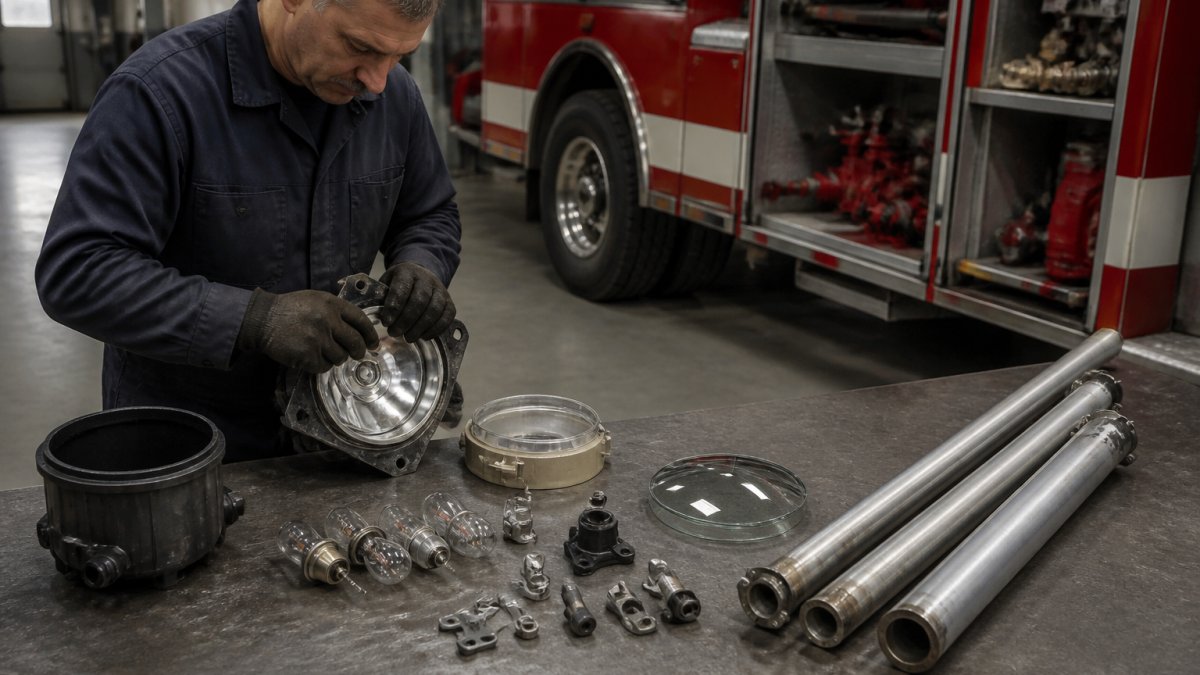
Bulbs for Focus, Optimum, and Magnafire Lampheads
Replacement bulbs are the highest-turnover item in any scene lighting inventory. Our Focus and Optimum bulb listing covers three technologies: quartz halogen, halogen infrared (HIR), and high intensity discharge (HID).
Quartz halogen uses a halogen gas fill that slows filament evaporation, which extends bulb life and keeps the light crisp white.
One handling note that matters more than people think: when you install a new bulb, avoid touching it except on the flat seal at either end.
Tempered Glass Lenses and Swivel Mounts
A cracked lens is a safety problem, not a cosmetic one. Tempered glass is designed to fail into small, blunt pieces rather than shards, and a compromised lens exposes the bulb and reflector to water and road debris.
We stock two lens kits. The Replacement Tempered Glass for Focus and Evolution II light heads at $151.33 fits the Focus 500, 750, 1000, and 1500 watt scene lights plus the Evolution LED. The Replacement Tempered Glass FRC Optimum light heads at $181.85 ships as a kit with the curved tempered glass and a new gasket.


Swivel mounts fail differently. The FRC Swivel Joint Mount Repair FC504K at $141.93 sits between the light head and the pole and fits Optimum, Focus, Spectra, and Evolution heads.
Poles, Bulb Clips, and Base Mounts
Pole assemblies are the most expensive lighting repair, and the most frequently misdiagnosed. The Inner Pole Replacement at $272.84 covers the 510, 512, 530, 540, and 542 in standard length, with or without inner cable. The FRC Outer Pole for 530/540 at $356.76 includes the locking mechanism.
Before you buy either, check whether the failure is the pole or the mount. A sticky locking collar often points to the outer pole; a floppy or seized head usually points to the swivel joint, which costs less than half as much.
The small hardware is where departments save the most. FRC Bulb Clips and Sockets run $109.20 for a two-clip kit and replace the original bulb electrical connection on Focus and Optimum lamp heads, quartz halogen only. Magnafire Bulb End Repair Clips are $78.98 for a two-clip kit fitting Magnafire 3000 and 5000 lamp heads. The Square Base Mount Replacement at $135.96 fits the CD-FX-12 Collins Dynamics spot and flood light and the SoBrite flood light.
How NFPA 1911 Compliance Parts Fit Into Your Replacement Plan
NFPA 1911 sets the standard for inspecting, testing, and maintaining in-service fire apparatus, and it shapes what counts as an acceptable repair. The NFPA 1911 standard for fire apparatus testing and maintenance covers the full inspection and performance testing program for emergency vehicles.
NFPA compliance parts are not a separate product category. They are the same components, ordered correctly. What makes a repair compliant is that the part matches the original specification and the work is documented.
That has three practical consequences for how you buy:
Bulbs, Focus, Optimum, Halogen Replacement →
- Match the wattage and voltage exactly. A 1000W 120V quartz bulb and a 1500W 240V quartz bulb are not interchangeable, even if they fit the same socket.
- Use the correct lens and gasket together. A lens kit without a fresh gasket leaves the assembly open to moisture.
- Record the part number on the repair order. Inspectors want to see what was installed, not just that something was.
What Separates Reliable Emergency Vehicle Parts Suppliers From the Rest
Reliable emergency vehicle parts suppliers publish real part numbers, real prices, and real stock status. Everything else is a promise.
Here is what we would check before placing a first order with any supplier:
- Part numbers on the listing. A listing that says "replacement bulb for FRC lights" without the manufacturer number is a coin flip.
- Fitment detail by model. The good listings name the lamp heads, the wattages, and the thread sizes.
- Published pricing. If you have to request a quote for a $78 clip kit, that supplier is not built for fleet maintenance.
- A phone number staffed by someone who knows the product. Our own listings tell customers to call when they want to confirm the right glass lens, and that call prevents most wrong-part orders.
- Warranty and returns terms stated up front.
The backorder question is the one that decides most supplier relationships. Ask any supplier what happens when an item is out of stock, and listen for a specific answer.
When Custom Fire Truck Equipment Fabrication Makes More Sense Than a Stock Part
Custom fire truck equipment fabrication makes sense when the failure is in the mounting, not the component. Stock parts cover the standard configurations, and most scene lighting repairs fall inside that range.
Custom work earns its cost in a few situations:
- Non-standard mounting geometry. A light head mounted to a bracket that no longer exists, or a pole location that changed during a refurbishment.
- Training props and special projects. Departments building burn props, forcible entry doors, or training structures need fabricated pieces that were never cataloged.
- Fleet-wide standardization. If you run twenty apparatus and want one mounting plate across all of them, a fabricated run can beat hunting for discontinued brackets.
What most guides miss is the timeline question. Custom fabrication adds design and lead time, so it only pays off when a stock part genuinely does not exist. For a cracked lens or a failed swivel joint, custom work is the wrong tool.
How to Verify Part Numbers Before You Buy Fire Truck Replacement Parts Online
Part number verification is the step that prevents most returns, and it takes about five minutes per part.
Work through this before you order:
- Photograph the failed component and any label or stamp on it
- Note the lamp head model and wattage from the housing
- Check the thread size on any mount or pole fitting (3/4 inch or 1 1/4 inch on FRC swivel mounts)
- Confirm whether your extension pole has wiring running down through it or a top wire
- Match the part number against the supplier's listing description, not just the photo
- Call the supplier if two listings look similar
The wiring configuration on extension poles is the single most common source of wrong orders. FC504K, FC504K-3, and FC504K-3-TW look nearly identical in a photo and fit completely different pole setups.
Conclusion: Matching the Part to the Failure
The hardest part of buying fire truck replacement parts online is not the ordering. It is diagnosing which component actually failed, because a flickering light and a dead light can share a symptom and not a cause.
At Traffic Safety System, we stock the lighting replacement parts that fail most often, from bulbs and clips to tempered glass and pole assemblies, and we fabricate custom mounting solutions when no stock part fits.
Get started with Traffic Safety System and keep your apparatus in service instead of parked behind a backorder.
Frequently Asked Questions
What should I look for when sourcing parts for older fire apparatus?
Start with the part number stamped on the failed component, not the truck's model year. Legacy scene lighting hardware is often shared across several lamphead generations, so a swivel joint mount listed for one model may fit three others. Confirm the thread size, voltage, and wattage before ordering, and keep a running parts catalog for each unit in your fleet so the next failure takes minutes to resolve instead of days.
How do I verify the compatibility of fire truck replacement parts before ordering?
Match three things: the lamphead series, the wattage or voltage rating, and the physical fitting. A 1000-watt quartz bulb and a 1500-watt quartz bulb may share a socket but not a power draw, and a tempered glass lens for a Focus 750 will not seal correctly on a 1500-watt housing. When the listing covers multiple models, call before you buy and confirm against your unit's service manual or exploded parts diagram.
Are there specific standards for fire truck replacement parts?
Replacement components should keep the apparatus performing to the standard it was built and tested against, and for fire apparatus that generally means NFPA 1911 for in-service testing and NFPA 1901 for the original build requirements. A replacement bulb, lens, or mount that restores the original rated output keeps your annual inspection clean. Substituting a lower-rated component can fail a test even when the light appears to work.
What are the best online suppliers for emergency vehicle components?
Look for three things: real inventory rather than drop-shipped listings, published part numbers you can cross-reference against your own records, and a phone number staffed by people who know the equipment. Pricing transparency matters too, since a supplier that hides cost behind a quote request adds days to a repair. A vendor that also fabricates or installs the equipment understands fitment problems that a pure reseller will not.
How fast can replacement parts ship when a light fails in the field?
That depends entirely on whether the supplier stocks the part or orders it in. Ask directly before you commit: is this on the shelf, and how many units? For common failure points like halogen bulbs, bulb clips, and swivel mounts, consider keeping spare parts on hand. Build that spare kit around the parts that fail most often on your specific fleet.