


Durable LED Lighting for Fire Trucks: 2026 Guide
Table of Contents
- Specs That Decide Whether Fire Truck Lighting Survives the Job
- NFPA 1901 Lighting Requirements: What Your Apparatus Must Meet
- IP67 vs IP69K Rated Truck Lights: Which Seal Level Holds Up
- Vibration-Resistant LED Work Lights: Why Mounting Kills More Lights Than Water
- Thermal Management and Power Draw: The Two Specs Nobody Checks Until a Light Fails
- Retrofitting vs OEM Integration on Existing Fire Apparatus
- Scene Lighting vs Warning Lighting: Two Different Jobs, Two Different Specs
- Conclusion
- Frequently Asked Questions
Last Updated: September 28, 2026
Specs That Decide Whether Fire Truck Lighting Survives the Job
Durable LED lighting for fire trucks is engineered to keep working through heat, vibration, water, and years of service without failing when a crew needs it most. At Traffic Safety System, we understand which fixtures come back for replacement and which outlast the apparatus they're bolted to. The difference almost never comes down to brightness, it comes down to how the light handles its environment.
NFPA 1901 Lighting Requirements: What Your Apparatus Must Meet
NFPA 1901, the Standard for Automotive Fire Apparatus, defines how a fire truck's lighting must perform before the apparatus is placed in service. It is not a single brightness number but a set of performance, mounting, and color requirements split across warning devices and scene work lighting, and it applies to new apparatus construction, which is why retrofit and replacement decisions must be checked against it rather than assumed.
What the standard actually governs
Three categories of requirement matter most when you are specifying or replacing fixtures:
- Warning device performance. The standard addresses the optical performance of warning lights, the intensity and visibility of the signal, along with color and mounting position. Warning lighting is judged on how far and how clearly it projects the emergency signal, not on raw lumen count.
- Mounting height and position. Warning devices are subject to mounting-height and placement provisions so the signal is visible from the angles approaching traffic actually occupies. A fixture that meets an output spec but sits at the wrong height or angle is non-compliant.
- Scene and work lighting. The standard also addresses the illumination crews need to work safely on scene, the lighting that lets a pump operator read a gauge or a crew advance a line. This is a separate requirement from warning visibility and is specified differently.
Why the edition matters
NFPA 1901 is revised on a cycle, and apparatus built to an older edition may not satisfy a newer one. Compliance is not a one-time event at delivery. When ordering replacement fixtures, confirm which edition your department is held to and whether existing mounting positions still satisfy it. A truck that fails inspection can be pulled from service, and mismatched retrofits can create liability exposure.
The retrofit trap
OEM apparatus arrives with lighting engineered to the edition in force at build time. When a department later swaps a lightbar, adds a scene light, or replaces a failed fixture, the new component must be evaluated against the same requirements, not just the old part it replaced. Most compliance gaps appear years later during a well-intentioned upgrade. Before any retrofit, document the edition your apparatus is held to, the mounting positions in use, and the color and performance requirements for each position, so you can specify a replacement that keeps the truck in service.
IP67 vs IP69K Rated Truck Lights: Which Seal Level Holds Up
IP67 and IP69K both describe how well a fixture keeps out dust and water, but they test different threats. IP67 means the housing survives temporary immersion; IP69K means it survives the high-pressure, high-temperature spray of a hose or pressure washer at the station.
Here's how the two compare in practice:
| Rating | Protects Against | Real-World Test | Best For |
|---|---|---|---|
| IP67 | Dust and temporary immersion | Submersion in water | Cab-interior and sheltered mounts |
| IP69K | Dust and high-pressure hot spray | Close-range pressure wash | Exterior apparatus-mounted lights |
Vibration-Resistant LED Work Lights: Why Mounting Kills More Lights Than Water
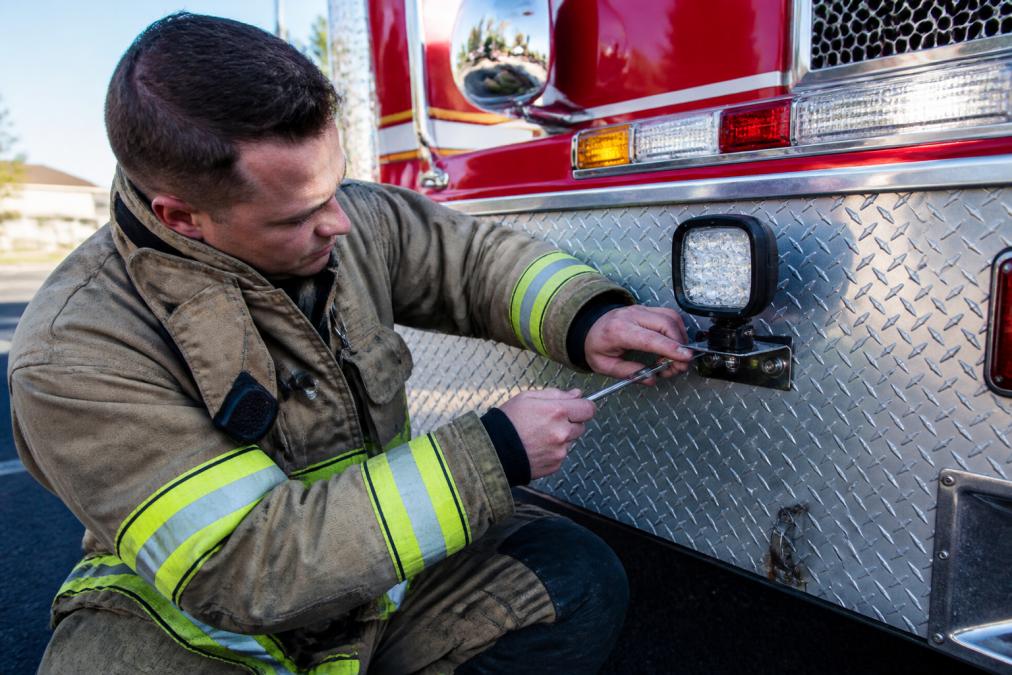
Vibration-resistant LED work lights fail more often from mounting than moisture. A fixture bolted rigidly to a frame that flexes will crack its housing, shear fasteners, or break internal solder joints long before water reaches the electronics. The truck's own motion is the enemy.
Thermal Management and Power Draw: The Two Specs Nobody Checks Until a Light Fails
Thermal management and electrical load get ignored until something fails. LEDs generate heat at the junction, and if that heat can't escape, output drops and lifespan shortens. A housing with enough surface area and a proper heat path keeps the LED cool, which is what actually delivers the rated lifespan.
A simple planning step prevents most of this:
- Add up the current draw of every fixture on the circuit
- Compare it against the alternator output and the wire gauge feeding that circuit
- Confirm the total stays within the circuit's rated capacity
- Size wiring and fusing for the new load, not the old one
Retrofitting vs OEM Integration on Existing Fire Apparatus
Retrofitting adds lighting to an apparatus already in service; OEM integration builds it in at the factory. Retrofits cost less up front and let you upgrade an aging fleet without buying new trucks, but they demand more attention to mounting, wiring, and load calculations.
Scene Lighting vs Warning Lighting: Two Different Jobs, Two Different Specs
Scene lighting and warning lighting are engineered against opposite optical goals, and treating them as interchangeable is one of the most common and expensive specification mistakes on a fire apparatus. Scene lighting illuminates a work area so crews can see; warning lighting makes the apparatus visible to approaching traffic. A fixture optimized for one is almost always wrong for the other.
The optical trade-off nobody explains
Warning lighting is judged on peak intensity, how bright the signal is at a specific point and angle, so it cuts through glare, weather, and distance. Scene lighting is judged on beam spread and uniformity, how evenly light covers a work zone without hot spots or dark corners.
Color, flash pattern, and mounting position
Warning lighting is further constrained by color and flash pattern. Emergency colors and flash sequences are specified so the signal is recognizable and does not confuse approaching drivers, and mounting position is governed so the signal is visible from the angles traffic actually approaches from. Scene lighting carries none of those constraints, its only job is to put usable light where the work happens, which is why scene fixtures are commonly mounted on the apparatus body, a boom, or a pole to get light above and around the work zone.
| Lighting Type | Primary Job | Key Spec | Typical Mount |
|---|---|---|---|
| Scene lighting | Illuminate the work area | Wide beam spread, even coverage | Apparatus body, boom, pole |
| Warning lighting | Alert approaching traffic | Peak intensity, color, flash pattern, height | Lightbar, beacon, body panels |
The electrical load interaction competitors skip
Here is the part most guides leave out: scene and warning lighting usually share the apparatus electrical system and often run at the same time. A crew working a scene may have the lightbar flashing, scene lights flooding the work area, and pump panel lighting on simultaneously. That combined draw is what the alternator and wiring actually carry, not the draw of any single fixture.
Conclusion
The hard part of durable LED lighting for fire trucks isn't finding bright fixtures. It's matching ingress protection, vibration tolerance, thermal behavior, and electrical load to how your apparatus actually gets used. Get those four right and the lights stay on for years; get them wrong and you're replacing fixtures every season while crews work in the dark.
Frequently Asked Questions
What IP rating is required for fire truck exterior lighting?
NFPA 1901 sets performance requirements for emergency vehicle lighting, but the IP rating itself comes from the IEC 60529 scale that manufacturers build to. For exterior fire truck lighting, IP67 is the practical minimum: it means the housing survives 30 minutes submerged in up to 1 meter of water. Apparatus-mounted lights exposed to direct hose spray and road spray should carry IP69K, which adds resistance to high-pressure, high-temperature washdown. Match the rating to where the light sits, not to the whole truck.
How does vibration resistance impact the lifespan of LED work lights?
Constant vibration from rough terrain and pump operation fatigues solder joints, connector pins, and mounting hardware long before the LEDs themselves wear out. A vibration-resistant LED work light uses potted circuit boards, locking connectors, and rubber-isolated mounts to absorb that energy. Lights without these features often fail at the bracket or the wiring harness within a few years, even when the diode package is rated for 50,000 hours. Check the mounting system before you check the lumen count.
Why is thermal management critical for high-output LED truck lights?
LEDs convert most of their power into light, but the remainder becomes heat that has nowhere to go in a sealed housing. High-lumen output lights without adequate heat sinking run hotter, which shortens diode life and causes color shift over time. Look for cast aluminum housings with visible fins, a metal-core circuit board, and a driver rated for continuous duty. A light that dims or flickers after 20 minutes of scene illumination is usually telling you its thermal path is undersized.
What is the difference between flood and spot LED patterns for fire apparatus?
Flood patterns spread light across a wide, short throw, which suits scene illumination around the apparatus, equipment staging, and patient care areas. Spot patterns concentrate the beam for long-distance reach, useful for search, access roads, and perimeter work. Most fire apparatus benefit from a mix: wide-pattern optics on the sides and rear for scene lighting, and one or two tighter beams aimed where crews actually walk. Beam spread should be chosen per mounting position, not per truck.
How do you maintain LED lighting systems on emergency vehicles?
LED lighting is largely maintenance-free, but the surrounding hardware is not. Wash housings and lenses regularly to keep light diffusion even, inspect mounting hardware for loosened bolts or cracked isolators, and check connector seals for corrosion after winter road treatment. Test every light under load during routine apparatus checks so a failing driver shows up before a call. Keep a small stock of replacement connectors and brackets, since those fail far more often than the light itself.
Can you retrofit LED lighting onto older fire apparatus?
Yes, and retrofitting is often cheaper than replacing a lightbar assembly. The main constraints are electrical load, mounting footprint, and wiring capacity. Measure the circuit's available amperage before adding high-output lights, and confirm the existing switch and fuse can carry the new draw. Adapter plates and custom brackets resolve most mounting mismatches.