


Vibration Resistant Work Truck Lights: 2026 Buying Guide
Table of Contents
- Why Vibration Resistant Work Truck Lights Matter for Fleet Operations
- How to Read Vibration, IP, and Impact Ratings Before You Buy
- LED vs. Halogen Truck Work Lights: Which Handles Vibration Better?
- Truck Work Lights for Rough Terrain: Matching Beam Pattern to the Job
- Work Light Mounting Brackets for Trucks: Locations That Reduce Vibration
- Wiring, Fusing, and Electrical Load Planning for Work Truck Lights
- Waterproof Work Lights for Trucks: Sealing Out Moisture and Dust
- Troubleshooting Vibration-Related Light Failures and Flickering
- Frequently Asked Questions
Last Updated: October 7, 2026
Why Vibration Resistant Work Truck Lights Matter for Fleet Operations
Vibration resistant work truck lights survive the constant shaking of every mile a service vehicle travels, the difference between a system that lasts years and one that fails in months.
A truck is a hostile environment for any electrical component.
Below, we break down how to read durability ratings, choose the right beam pattern, mount lights where vibration is lowest, and wire everything to survive the long haul.
How to Read Vibration, IP, and Impact Ratings Before You Buy
Ratings tell you what a light has been tested to survive, so reading them prevents overpaying for protection you do not need or underbuying for the conditions you face. Three systems matter most: vibration and shock testing, ingress protection (IP), and impact resistance.
Ingress protection (IP) is a two-digit standard rating how well a housing keeps out solid particles and liquid: the first digit covers dust and debris, the second covers water.
What IP67 and IP69 Actually Mean for Truck Lights
IP67 means dust-tight and able to survive temporary immersion, rain, spray, the occasional deep puddle. IP69 is rated for high-pressure, high-temperature water jets, like a wash-down or heavy highway spray.
For most fleet use, IP67 is the practical floor and IP69 is the better choice for vehicles that see regular pressure washing. The FRC WorkPro LED Lampheads, for example, carry an IP67 and greater waterproof rating.

Impact Resistance and Shatter-Proof Lens Materials
Impact resistance is about the lens and housing surviving road debris, a dropped tool, or a branch. Polycarbonate lenses resist cracking far better than glass, and cast aluminum housings absorb impact without deforming like thin stamped metal. Look for a shatter-proof lens and a cast, not stamped, housing.
| Rating | What It Protects Against | Minimum for Fleet Use |
|---|---|---|
| IP67 | Dust, temporary water immersion | Yes, baseline |
| IP69 | High-pressure, hot water jets | Preferred for wash-down fleets |
| Polycarbonate lens | Impact, cracking, shattering | Yes, baseline |
| Cast aluminum housing | Impact, corrosion, heat | Yes, baseline |
LED vs. Halogen Truck Work Lights: Which Handles Vibration Better?
LED work lights handle vibration better than halogen because they have no filament to break. A halogen bulb's thin tungsten filament fatigues and snaps under constant vibration; an LED has no fragile internal parts, so shock and vibration have far less to destroy.
That single difference drives most of the practical trade-offs:
- Service life: LEDs are rated for tens of thousands of hours, while halogen bulbs typically fail far sooner under vibration.
- Current draw: LEDs produce more light per amp, so they pull less from the electrical system. The SoBrite LED Compact draws 5 amps at 12 VDC.
- Heat: Halogen converts much of its energy into heat, which shortens bulb life and stresses nearby wiring.
Halogen survives only in legacy equipment with older housings that fleets do not want to rewire, and even there, most eventually convert because the bulb replacement cycle eats the savings.

Truck Work Lights for Rough Terrain: Matching Beam Pattern to the Job
Beam pattern matters more than raw brightness on rough terrain, because the wrong pattern throws light where you cannot use it.
Beam angle is measured in degrees of spread. A narrow beam (roughly 10 to 20 degrees) concentrates light into a long throw; a flood (roughly 60 to 120 degrees) spreads it wide and short; a trapezoid or combination sits between them, wider than a spot and longer than a flood.
- Spot beam (narrow angle): A focused, concentrated long-range beam for illuminating objects at a distance. Best for scouting ahead or lighting a specific far target. On rough terrain, a spot is the most vulnerable to vibration because a small shake moves the hot spot a large distance at range.
- Flood beam (wide angle): The widest pattern, for evenly lighting a work area close to the vehicle. Best for scene work and repairs. Because the light is spread out, a small shake barely moves the illuminated area, so flood patterns hold up best under vibration.
- Trapezoid or combination: Wider than a spot and longer than a flood, useful as a general work light and for front-of-vehicle visibility while driving.
How Mounting Height and Aiming Change What You See
Mounting height does most of the work in determining coverage. A flood mounted low on a bumper throws light forward and slightly down, ideal for the ground ahead; the same flood high on a headache rack throws light over the work area and can wash out the near ground with glare.
Aim a work-area flood so the beam's lower edge lands at the near edge of the task and the upper edge reaches the far edge, keeping the pattern's center on the work rather than the operator's eyes.
Matching Patterns to Common Truck Tasks
- Roadside repair or scene work: Flood or combination aimed down at the work area, mounted low or mid-height.
- Scouting ahead on unimproved surfaces: Spot aimed forward, mounted high, accepting that vibration will move the hot spot.
- Front-of-vehicle driving visibility: Trapezoid or combination, aimed to fill the lane without blinding oncoming traffic.
For a truck that works at night on unimproved surfaces, we usually recommend a flood or trapezoid pattern for the work area and a spot for distance.
Work Light Mounting Brackets for Trucks: Locations That Reduce Vibration
Mounting location decides how much vibration a light experiences, so the bracket and spot matter as much as the light itself. The farther a light sits from the frame and the longer its mounting arm, the more it amplifies every bump.
Locations that reduce vibration exposure:
FRC WorkPro LED Lampheads Work Lights →
- Cab roof or headache rack: Close to the body, short mounting arms, low amplification.
- Bumper or grille: Solid mounting points tied directly to the frame.
- Recessed mounts: Set into a surface so the housing is supported on multiple sides.
Locations that increase vibration exposure:
- Long pole mounts with no bracing
- Bed-mounted arms that cantilever far from the mounting point
- Any bracket attached to thin sheet metal rather than the frame
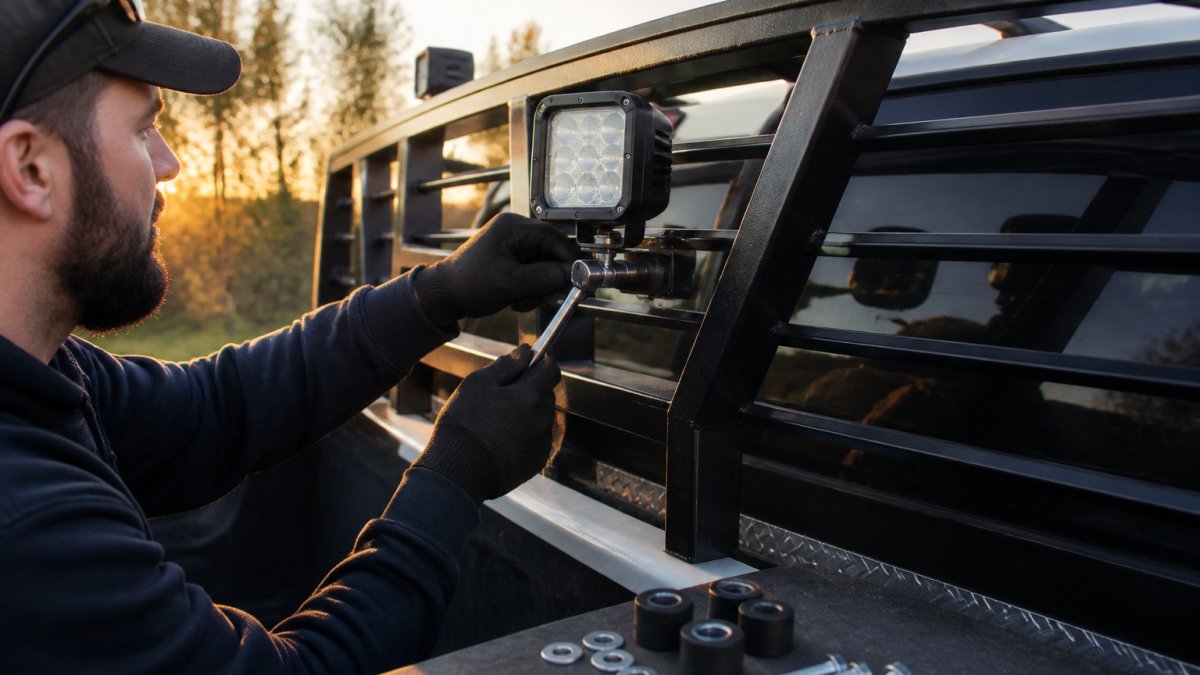
Anti-Vibration Bushings and Magnetic Base Options
Anti-vibration bushings sit between the bracket and mounting surface, absorbing high-frequency shake before it reaches the housing, inexpensive and one of the highest-value upgrades you can make. A magnetic base is different: fast to reposition for temporary setups, but it depends on grip strength. A 100-pound-grip base holds steady on smooth steel, though it is no substitute for a bolted mount on constant rough terrain.
Wiring, Fusing, and Electrical Load Planning for Work Truck Lights
Wiring is where good lights get ruined: a vibration-resistant light can still fail if its power supply is not. Plan the electrical load before mounting anything.
Total the current draw of every light on the circuit. The SoBrite LED Compact draws 5 amps at 12 VDC, and FRC WorkPro models range from 1,600 to 7,200 lumens, so draw varies by model.
A few rules to follow on every install:
- Fuse every circuit at or just above the total rated draw, never above the wire's capacity.
- Use a relay for any circuit drawing meaningful current, so the switch carries only the trigger signal.
- Support the wire every few inches with clips or loom, because unsupported wire flexes with vibration and work-hardens until it breaks.
For fleets working in salt spray and extreme cold, sealed connectors and tinned wire are worth considering.
Waterproof Work Lights for Trucks: Sealing Out Moisture and Dust
Waterproof work lights for trucks depend on a seal that stays intact through years of temperature cycling, and that is where cheap lights fail first. As a housing heats and cools, the air inside expands and contracts; a weak seal lets that cycle pull moisture in, and corrosion and short circuits follow.
Why Temperature Cycling Beats Seals
A sealed housing is a small pressure vessel. Running warms the internal air, pushing outward against the gasket; shutting off in cold weather cools and contracts it, pulling a slight vacuum that draws water and dust past a marginal seal. Over hundreds of cycles, a gasket that was fine on day one takes a compression set, it stays flattened and stops sealing.
Reading IP Ratings in Context
IP67 means dust-tight and able to survive temporary immersion; IP69 is rated for high-pressure, high-temperature water jets like those in a wash-down bay. For most fleet use, IP67 is the practical floor and IP69 is better for vehicles that see regular pressure washing. But the rating does not describe gasket material, seal design, or how the housing behaves after years of heat cycling.
Dust, Grit, and the Lens Surface
Dust protection works like water protection, but the failure mode is abrasion rather than corrosion. A dust-tight housing keeps abrasive grit away from the lens and internal electronics, critical on construction sites, gravel yards, and unpaved job sites. Grit wiped repeatedly off a soft plastic lens hazes it over time; polycarbonate resists this better than acrylic.
What to Look For Beyond the Rating
- Cast aluminum housing: Resists corrosion and helps shed heat, which reduces the temperature swing that drives moisture ingress.
- Silicone or high-quality gaskets: Resist compression set better than generic rubber.
- Sealed or potted circuitry: Protects electronics even if a small amount of moisture enters.
The FRC WorkPro LED Lampheads are designed to withstand shock, RFI/EMI interference, voltage surges, UV, and reverse polarity, and their cast aluminum housing and polycarbonate lens are built for harsh work environments. That combination of a sealed housing, a tough lens, and protected circuitry is what keeps moisture and dust out over the long term.
Troubleshooting Vibration-Related Light Failures and Flickering
Flickering and intermittent failures almost always trace back to a connection or mounting problem, not a dead light. Before replacing anything, work through the likely causes in order.
- Check the ground connection. A loose or corroded ground is the most common cause of flickering.
- Inspect the wire at the mounting point. Vibration breaks wire where it flexes most, usually right at the bracket or the connector.
- Look for a cracked solder joint. If the light works when tapped but not when still, an internal joint has failed.
- Check the seal and housing. Moisture inside the lens points to a failed gasket.
- Verify the mount is tight. A loose bracket lets the light shake harder than the housing was designed to handle.
If a light fails repeatedly in the same location, the mount may be the problem. Moving it closer to the frame or adding bushings may help before replacing the unit.
Vibration kills more work truck lights than anything else on the road, and the fix is a system: the right ratings, the right beam pattern, a low-vibration mount, and wiring that can take the shake. Our lineup includes the IP67-rated FRC WorkPro LED Lampheads, the 7,000-lumen SoBrite LED Compact with spot, flood, and trapezoid lenses, the low-profile CrestLight with built-in DOT markers, and the hitch-mounted 11,000-lumen scene light for rapid setup.

Frequently Asked Questions
Are LED or halogen work lights more resistant to vibration?
LED work lights handle vibration better than halogen. Halogen bulbs use a fragile filament that can break or loosen from constant shaking on rough terrain. LEDs have no filament, so they resist shock and vibration far longer. The FRC WorkPro LED Lampheads are built to withstand shock and carry an IP67 or greater waterproof rating, making them a practical choice for trucks that spend hours on unpaved roads.
What mounting features help prevent truck work lights from loosening?
Anti-vibration bushings, lock washers, and thread-locking compound are the three features that keep lights tight. Mount to a reinforced surface rather than thin sheet metal. Yoke mounts and recessed mounts distribute load better than single-bolt brackets. The FRC WorkPro series offers both yoke and recessed mount models, and the SoBrite LED light weighs only 2.5 pounds, which reduces stress on the mounting surface and bracket over time.
How can you protect work truck lights from water, dust, and vibration?
Choose lights rated IP67 or higher, mount them where spray and road debris hit least, and use anti-vibration bushings at every contact point. Die-cast aluminum housings with polycarbonate lenses resist corrosion and impact. The CrestLight LED scene lights use an aluminum housing with cooling fins and carry a five-year warranty. For fleets running in salt spray or extreme cold, sealed connectors and tinned wire can help prevent moisture from reaching the wiring.
How do you troubleshoot a work light that flickers after installation?
Flickering usually traces to a loose ground, a failing connection at the fuse tap, or a mounting point that lets the light vibrate against its bracket. Check the ground first: a poor chassis ground causes most intermittent flicker. Then inspect the fuse and relay for corrosion. If the light still flickers, remove it and check the bracket and bushing for wear. A light that flickers only on rough roads may point to a vibration issue, rather than an electrical one.