


Heavy Duty Lighting for Utility Fleets: 2026 Buyer's Guide
Table of Contents
- What Utility Fleet Managers Should Look For in Heavy Duty Lighting
- Quick Comparison: LED Scene Lights for Work Trucks
- LED Work Lights for Utility Trucks: Top Picks by Use Case
- Commercial Vehicle Lighting Regulations and Safety Compliance
- Fleet Lighting Maintenance Best Practices That Cut Downtime
- Total Cost of Ownership: Budgeting Heavy Duty Lighting Across 20+ Vehicles
- Installation, Mounting, and Retrofitting Without Pulling Mechanics Off the Line
- Frequently Asked Questions
Last Updated: October 2, 2026
What Utility Fleet Managers Should Look For in Heavy Duty Lighting
Heavy duty lighting for utility fleets means high-output, weather-sealed LED fixtures built to survive vibration, salt spray, and temperature swings. This guide from Traffic Safety System covers what matters when specifying fixtures for 20 or more vehicles.
- Lumens and beam pattern, flood for ground coverage, spot for reach
- Ingress protection, IP67 or better for washdown and rain
- Shock and vibration resistance, sealed electronics, no exposed contacts
- Voltage compatibility, 12/24 VDC for most utility trucks
- Mounting and serviceability, can your techs swap it without pulling the vehicle?
Quick Comparison: LED Scene Lights for Work Trucks
The table below compares the FRC scene lights Traffic Safety System stocks, sorted by output and price.
| Model | Lumens | Price | Best For |
|---|---|---|---|
| FRC SPECTRA SPA100 | 20,000 | $2,101.17 | Tight budgets, standard scene work |
| Spectra MAX SPA100 | 28,000 | $3,214.00 | Long-reach scene illumination |
| Spectra MAX-S | 28,000 | $3,462.55 | Spot-heavy distance work |
| Spectra LED MAX 28000 L | 28,000 | $2,744.96 | Pole-mounted configurations |
| Radiant Max | 32,000 | $2,508.00 | Maximum output per fixture |
| Radiant Lux Surface Mount | 22,000 | $2,069.05 | Surface-mount retrofits |
| SPA900-Q70 | 7,000 | $667.40 | Ambulance and loading lights |
| SPA950-Q50 | 5,000 | $425.31 | Perimeter and egress lighting |
| FireFly LED100-Q01 | 650 | $176.00 | Compartment lighting |
| SUNSTRIP LED200 | 300 per 18 in | $80.00 | Strip lighting, walkways |
LED Work Lights for Utility Trucks: Top Picks by Use Case
No single fixture fits every truck in a mixed fleet. Match the light to the job to spend less per vehicle and get better coverage where it counts.

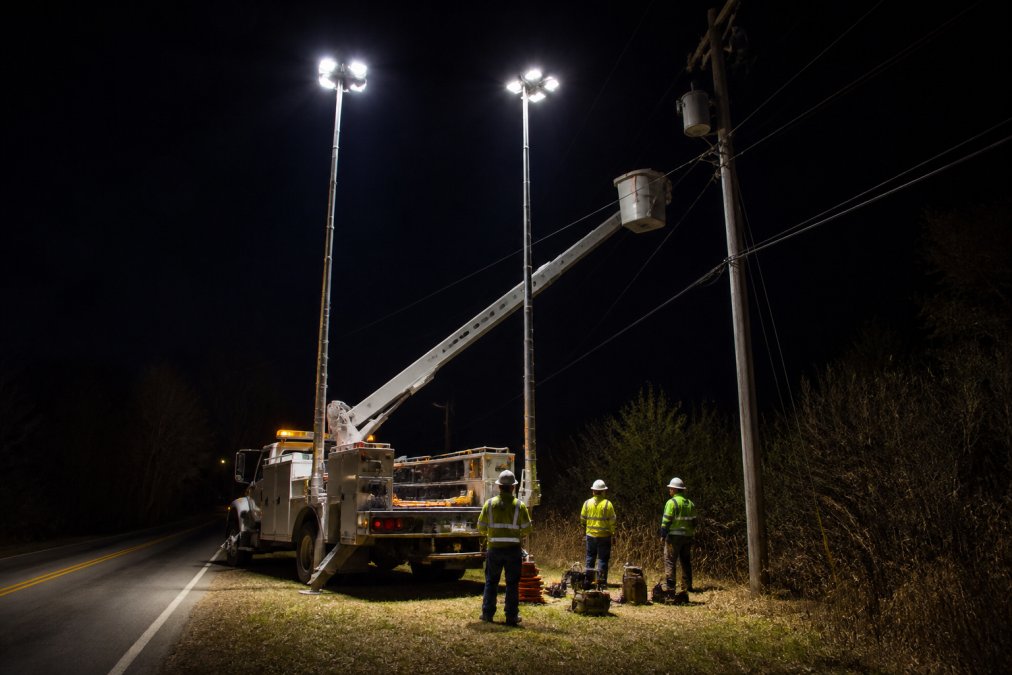
FRC SPECTRA LED Lampheads SPA100: 20,000 Lumens for Tight Budgets
The SPA100 is the value pick in the FRC lineup, putting 20,000 lumens on the work area through a three-row design: flood LEDs top and bottom for ground coverage, spot LEDs in the middle for distance.
Spectra MAX and MAX-S: 28,000 Lumens for Long-Reach Scene Work
Both MAX models output 28,000 lumens but distribute it differently. The Spectra MAX ($3,214.00) uses 60 flood and 12 spot LEDs for wide scene coverage; the MAX-S ($3,462.55) splits 36 flood and 36 spot for more reach. Both are direct replacements for worn halogen or HID heads, shipping with wiring for existing harnesses and a 3/4-inch pipe thread mount, a same-day swap, not a shop project.
Radiant Max and Radiant Lux: 32,000 and 22,000 Lumens With CANbus Control
The Radiant Max is the highest-output fixture in the lineup at 32,000 lumens, $2,508.00. It runs on 220W, carries an IP68 rating against dust and continuous immersion, and operates to 115°F without derating. The Radiant Lux surface mount delivers 22,000 lumens at $2,069.05, drawing just 150W, roughly a third less power for two-thirds the output. Both offer optional CANbus control for dimming and independent spot/flood switching, which separates them from commodity work lights for fleets running telematics or multiplexed body controls.
Surface-Mount Options: SPA900-Q70, SPA950-Q50, FireFly, and SUNSTRIP
Four surface-mount and compartment fixtures round out a truck build:
- SPA900-Q70 ($667.40), 7,000-lumen flood and loading light for ambulance and emergency response vehicles. Low profile, extends less than 1-3/4 inches, no panel cutout required.
- SPA950-Q50 ($425.31), 5,000-lumen perimeter light with an ultra-wide pattern for the area directly alongside the vehicle. Works as an egress or backup light.
- FireFly LED100-Q01 ($176.00), 650-lumen compartment light, 2-5/8 inch diameter, mounts in any orientation. Five-year warranty.
- SUNSTRIP LED200 ($80.00), 300 lumens per 18 inches, waterproof and submersible, available in 9-inch increments up to 63 inches.
Commercial Vehicle Lighting Regulations and Safety Compliance
Commercial vehicle lighting regulations in the United States are enforced through FMCSA vehicle lighting requirements for interstate commercial vehicles, with additional state-level rules for municipal and utility fleets. Scene lighting itself is largely unregulated; what's regulated is marker lights, taillights, and conspicuity.
Fleet Lighting Maintenance Best Practices That Cut Downtime
Fleet lighting maintenance best practices come down to inspection frequency, failure-mode knowledge, and part availability. Most lighting failures are preventable, and the rest are cheap to fix if the part is on the shelf.
A practical maintenance cadence:
- Weekly: Visual walkaround. Look for cracked lenses, condensation behind the lens, dark LEDs in a multi-emitter array, and chafed pigtails at the strain relief.
- Monthly: Function test every scene light, marker light, and taillight. Cycle through flood-only, spot-only, and combined modes if the fixture supports independent switching.
- Quarterly: Check mounting hardware torque and pole mechanisms. On pull-up and push-up poles, inspect the telescoping sections for galling and the handrail outer tube for cracks.
- Annually: Clean lens surfaces, inspect wiring at strain reliefs, and verify the ground path on any fixture that shares a chassis ground with body equipment.
The Four Failure Modes That Actually Sidelined Utility Trucks
Most lighting downtime traces back to a few causes:
- Moisture ingress at the gasket. A fixture rated IP67 or IP68 can still fail if the lens gasket is pinched during a lamphead swap or the housing is over-torqued. Condensation after a washdown is the tell.
- Vibration fatigue at the mount. Washboard gravel and potholed access roads work-harden mounting arms and pole pivots. A fixture that passes a static shake test can still crack a bracket at 40,000 miles.
- Voltage drop on undersized conductors. Older trucks wired for halogen loads sometimes run conductors that are marginal for a modern LED fixture drawing full current at startup. Symptoms look like a failed driver but are actually a wiring problem.
- Driver failure from heat soak. A fixture mounted where it can't shed heat, behind a toolbox, against a body panel, will derate or fail earlier than the same fixture in open air.
Where Telematics Changes the Maintenance Equation
With telematics or a multiplexed body control module, lighting stops being a purely visual inspection item.
- Fault codes and current monitoring. A body control module that logs circuit current can flag a fixture drawing outside its expected range before the driver notices a dim or dead lamp, turning a roadside failure into a scheduled shop visit.
- Usage hours per fixture. Telematics can log when scene lights are energized, letting you schedule replacement by actual runtime rather than calendar interval. A truck running scene lights two hours a week reaches end-of-life far later than one running them twenty.
- Geofenced inspection prompts. Some fleet platforms trigger a DVIR prompt when a vehicle returns from a known rough-terrain job site, exactly when you want a mounting-hardware check.
Standardization, Spares, and the Real Cost Driver
The biggest cost driver isn't the fixture, it's the downtime. A truck sidelined a week waiting on a backordered lamphead costs far more than the part. Standardize on a few models so one spare covers multiple vehicles, and keep one spare lamphead, mounting arm, and gasket kit per model on the shelf.
FRC SPECTRA LED Lampheads SPA100 →
Total Cost of Ownership: Budgeting Heavy Duty Lighting Across 20+ Vehicles
Most competitors stop at purchase price, the wrong number for a budget meeting. Total cost of ownership for fleet lighting is purchase price plus installation labor, maintenance, downtime, and incident cost, divided across service life. Here's how to build a model that survives finance scrutiny.
The Five Line Items in a Defensible TCO Model
- Acquisition. Lamphead, mount, wiring harness, and any brackets. This is the only line item most spreadsheets capture.
- Installation labor. Direct-replacement lampheads that reuse an existing pole mount and harness are measured in minutes per truck; surface-mount fixtures that require panel work or new harness runs are measured in hours. The labor delta between a same-day swap and a shop project is often larger than the price delta between two lampheads.
- Maintenance. Gaskets, mounting hardware, and occasional driver replacement. LED fixtures rated at 50,000 hours rarely need lamphead replacement inside a ten-year service life, but mounts and gaskets do wear.
- Downtime. The cost of a truck out of service. This line item flips budget-tier decisions, and it's the one most fleets estimate badly.
- Incident exposure. The cost of a lighting-related failure at a recovery or roadside scene. Hard to quantify, but it belongs in the conversation because it's the reason premium output exists.
Running the Math on a 24-Truck Fleet
A 24-truck fleet with two scene lights per truck is 48 fixtures: roughly $100,000 in lampheads at the SPA100 price point, or closer to $120,000 at the Radiant Max price point. Spread across a ten-year service life, that gap is a small fraction of the total, while downtime and incident exposure dominate, the argument for specifying for the job rather than the invoice, but you have to show the math.

A Simple TCO Worksheet You Can Reuse
Build the model in a spreadsheet, one row per fixture model under consideration:
| Line item | How to estimate |
|---|---|
| Acquisition per truck | Lamphead price × fixtures per truck, plus mounts and harness |
| Install labor per truck | Mechanic hours × loaded labor rate |
| Annual maintenance | Gasket and hardware kit cost × expected replacement interval |
| Annual downtime | Expected failures per year × hours out of service × cost per hour |
| Incident exposure | Qualitative score, 1-5, weighted by scene complexity |
| Service life | Rated hours ÷ expected annual runtime |
Sector-Specific Assumptions Change the Answer
The right TCO inputs differ by utility sector:
- Electric utility fleets often work energized or near-energized equipment, so scene lighting that supports safe approach distances and clear visual confirmation of grounding matters more than raw lumen count. Downtime cost is high because crew time is expensive and outages are measured in customer-minutes.
- Water utility fleets work in wet, muddy, and sometimes confined spaces. IP68 sealing and corrosion resistance drive maintenance cost more than output does.
- Gas utility fleets work in excavation and leak-response scenarios where wide, even ground coverage beats long-throw spot. A fixture that throws light 200 feet but leaves the trench floor in shadow is the wrong tool.
Run the worksheet three times with sector-appropriate assumptions before standardizing across a mixed fleet. A single fleet-wide spec usually overpays on some trucks and underpays on others.
Installation, Mounting, and Retrofitting Without Pulling Mechanics Off the Line
Retrofitting LED lighting onto existing utility trucks is faster than most fleet managers expect, provided you match the mount to existing hardware. The FRC lineup is built around this.
Three retrofit paths cover most situations:
- Direct replacement, MAX and MAX-S lampheads ship with wiring and a 3/4-inch pipe thread mount that drops into existing pole mounts. Swap time is measured in minutes.
- Surface mount, SPA900-Q70, SPA950-Q50, and Radiant Lux attach to flat panels with four screws. No panel cutout required on the SPA900.
- Compartment and strip, FireFly and SUNSTRIP mount in any orientation on any flat surface, with optional 45-degree and 90-degree stainless brackets.
Frequently Asked Questions
What are the durability requirements for utility fleet lighting?
Utility fleet lights need sealed housings, shock and vibration resistance, and wide operating temperature ranges. Look for IP68-rated fixtures like the Radiant Max and Radiant Lux, which hold full output at ambient temperatures up to 115°F without derating. Anodized aluminum housings, waterproof strain reliefs, and LED life ratings around 50,000 hours all matter when trucks run salt spray, rough terrain, and constant vibration. Heavy duty lighting built to these specs survives years of daily service instead of failing mid-job.

What is the difference between flood and spot lighting for work trucks?
Flood LEDs spread light across a wide area, lighting the ground and work zone around the truck. Spot LEDs focus a narrow, intense beam that reaches objects far down the road or across a recovery site. Combination lampheads give you both: the FRC SPECTRA SPA100 uses top and bottom flood rows plus a middle spot row, while the Spectra MAX-S lets you select 14,000 lumens of spot, 14,000 lumens of flood, or the full 28,000-lumen combination. Match the mix to your most common job site.
How does heavy duty lighting impact fleet maintenance costs?
LED fixtures rated at 50,000 hours cut replacement frequency compared with halogen or HID heads, and lower current draw reduces alternator and battery strain. The FireFly compartment light draws just 0.8 amps at 12 VDC, and the SUNSTRIP strip light carries a five-year warranty. Fewer failures mean fewer shop hours and less operational downtime. When budgeting, compare purchase price against lamp replacement labor and vehicle out-of-service days over the fixture's full service life.
Are there specific SAE standards for utility vehicle emergency lighting?
Scene lighting itself is not covered by one universal SAE number, so fleet managers should verify fixtures carry relevant photometric testing and meet state vehicle codes for work zones. Check your state's commercial vehicle lighting regulations before specifying new equipment, and keep documentation on file for inspections.
How do LED lighting upgrades improve utility fleet safety?
Instant-on LEDs reach full intensity the moment they're switched, so crews aren't waiting for halogen lamps to warm up at a recovery site. Wider, more uniform beam patterns reduce glare and visual fatigue during long night operations, and perimeter lights like the SPA950-Q50 illuminate the area directly beside the vehicle where technicians walk. Better visibility lowers the risk of struck-by incidents and slip hazards, which is the main reason utility fleets prioritize heavy duty lighting upgrades.